
After a collision, one of the most serious concerns for any vehicle owner is frame damage. While dents and scratches are visible and easy to understand, frame damage can be hidden beneath the surface—yet it affects everything from your vehicle’s safety to its resale value. If you’ve been in an accident in Medford, Oregon, understanding frame damage is essential for making informed decisions about your vehicle’s future.
At Rogue Auto Body, we use state-of-the-art diagnostic equipment to identify and repair frame damage, ensuring your vehicle is restored to manufacturer specifications. This comprehensive guide will help you understand what frame damage is, how to spot it, and what your repair options are.
What Is Frame Damage?
Frame damage refers to any deformation of your vehicle’s primary structural components — the unibody on most modern cars, or the separate frame on trucks and SUVs. These structures are engineered to absorb and redirect collision energy to protect occupants. When damaged, they must be restored to exact factory tolerances or they cannot perform that function in a subsequent crash.
Your vehicle’s frame is its structural backbone. It’s the foundation that supports everything else—the engine, suspension, body panels, and safety systems. When we talk about frame damage in Medford collision repairs, we’re referring to any bending, cracking, or warping of this critical structural component.
Types of Vehicle Frames
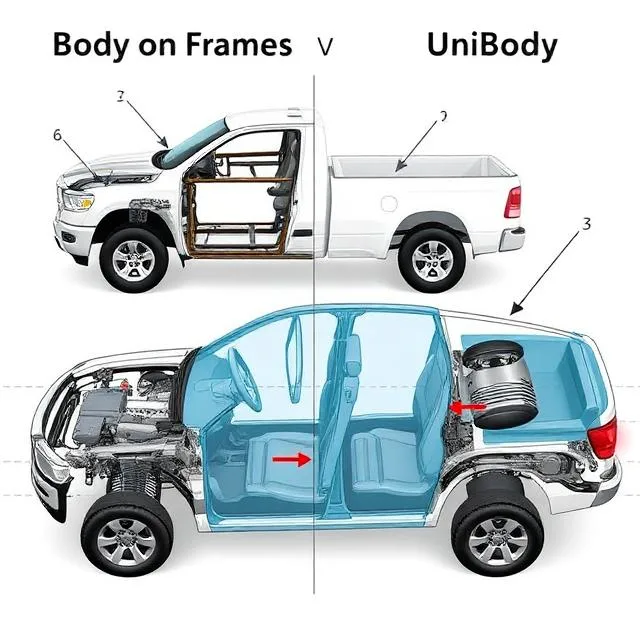
Modern vehicles use two main frame designs:
Body-on-Frame Construction: Common in trucks and SUVs, this design features a separate ladder-style frame with the body mounted on top. Vehicles like the Ford F-150, Toyota Tacoma, and Jeep Wrangler use this construction. Frame damage in these vehicles often involves the ladder frame rails.
Unibody Construction: Most modern cars, crossovers, and some SUVs use unibody design, where the frame and body are integrated into a single structure. This includes vehicles like the Honda Accord, Toyota Camry, and most crossover SUVs. Damage to any structural component affects the entire vehicle.
7 Warning Signs Your Vehicle Has Frame Damage
Key indicators of frame damage include uneven panel gaps, doors or windows that bind or won’t close properly, the vehicle tracking sideways rather than straight, unusual creaking or popping sounds, visible bending or wrinkling of structural components, uneven tire wear, and a steering wheel that isn’t centered when driving straight. Not all frame damage is visible — professional diagnostic equipment is required to confirm.
Frame damage isn’t always visible to the naked eye, but your vehicle will often show telltale signs. If you notice any of these symptoms after a collision in the Medford area, bring your vehicle to a certified collision repair shop for a professional inspection:
1. Visible Bending or Damage
The most obvious sign is visible damage to the frame rails, subframe, or structural components. Look underneath your vehicle for any signs of bending, cracking, or deformation. Even minor bends can indicate serious structural compromise.
2. Uneven Gaps Between Panels
When the frame is bent, body panels no longer align properly. Check the gaps between:
- Doors and door frames
- Hood and fenders
- Trunk lid and quarter panels
- Bumpers and body panels
Uneven gaps—wider on one side than the other—often indicate frame misalignment.
3. Doors That Won’t Close Properly
If doors stick, won’t latch, or require extra force to close, the door opening may have shifted due to frame damage. This is one of the most common symptoms we see at our Medford auto body shop.
4. Vehicle Pulls to One Side
A bent frame can throw off your vehicle’s alignment, causing it to pull left or right even on straight roads. If you’ve had an alignment done but the pulling persists, frame damage may be the culprit.
5. Unusual Tire Wear
Frame damage affects wheel alignment geometry, leading to:
- Uneven tire wear patterns
- Inner or outer edge wear
- Rapid tire degradation
- Different wear on left vs. right tires
6. Strange Noises While Driving
A compromised frame can cause:
- Creaking or squeaking sounds, especially over bumps
- Rattling from misaligned components
- Clicking noises during turns
7. Visible Suspension Damage
The suspension mounts directly to the frame. If you see bent control arms, damaged strut towers, or misaligned suspension components, the frame itself may be compromised.
Why Frame Damage Is a Serious Safety Concern
A compromised frame cannot absorb and redirect collision energy the way it was engineered to. In a subsequent accident, more force reaches occupants rather than being dissipated by crumple zones. Airbag deployment timing can also be affected by frame damage. This is why frame repair must restore exact factory measurements — not just approximate straightness.
Driving with unrepaired frame damage isn’t just uncomfortable—it’s dangerous. Here’s why frame damage repair should be a top priority:
Compromised Crash Protection
Modern vehicles are engineered with specific crumple zones designed to absorb impact energy and protect occupants. A bent or weakened frame may not perform as designed in a subsequent collision, putting you and your passengers at significantly higher risk of injury.
Airbag Deployment Issues
Airbag sensors are calibrated based on the vehicle’s original structure. Frame damage can affect sensor positioning and timing, potentially causing:
- Delayed airbag deployment
- Failure to deploy when needed
- Unexpected deployment
Handling and Control Problems
A misaligned frame affects your ability to control the vehicle, especially during:
- Emergency maneuvers
- Hard braking
- Wet or slippery conditions
- Highway driving
Accelerated Component Wear
Frame damage puts abnormal stress on other components, leading to premature failure of:
- Tires
- Suspension components
- Steering components
- Drivetrain parts
How We Diagnose Frame Damage at Rogue Auto Body
Rogue Auto Body uses a Chief frame rack with a Vector computerized measuring system to diagnose frame damage. Laser-guided sensors map your vehicle’s actual dimensions against factory specifications at dozens of measurement points simultaneously. This diagnostic report documents exact deviations before, during, and after repair — providing objective proof of restoration to factory tolerances.
Accurately diagnosing frame damage requires specialized equipment and expertise. Here’s how our Medford collision center identifies structural damage:
Computerized Measuring Systems
We use laser-based and electronic measuring systems that compare your vehicle’s current dimensions to manufacturer specifications. These systems can detect misalignment as small as 1-2 millimeters—far more precise than visual inspection alone.
3-Point and Multi-Point Analysis
Our diagnostic process checks multiple reference points throughout the vehicle’s structure, including:
- Frame rail measurements
- Strut tower positions
- Control arm mounting points
- Engine cradle alignment
- Roof rail positions
- Floor pan measurements
Visual and Physical Inspection
Our I-CAR certified technicians also conduct thorough visual inspections, looking for:
- Cracked or flaking undercoating (indicates stress)
- Wrinkled metal or paint
- Evidence of previous repairs
- Weld integrity issues
- Rust formation at stress points

The Frame Straightening and Repair Process
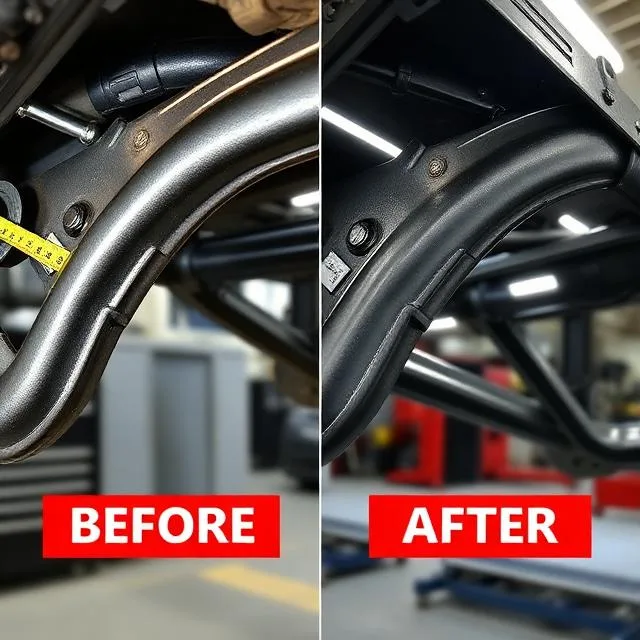
Frame straightening uses hydraulic equipment mounted to a Chief frame rack to apply controlled force at precise points, gradually restoring the structure to factory dimensions. The Vector measuring system provides real-time feedback throughout the process. Multiple measurement cycles confirm that all dimensions are within manufacturer tolerances before the vehicle moves to the next repair stage.
When frame damage is confirmed, our Medford frame repair specialists follow a precise process to restore your vehicle’s structural integrity:
Step 1: Complete Disassembly
We remove all components that could interfere with the repair or hide additional damage. This typically includes bumpers, fenders, suspension components, and sometimes the engine or drivetrain.
Step 2: Frame Rack Mounting
Your vehicle is secured to a frame straightening machine (also called a frame rack). This specialized equipment uses hydraulic towers and chains to apply controlled force to bent areas while holding the rest of the vehicle stable.
Step 3: Precision Straightening
Using manufacturer specifications and our computerized measuring system, we carefully apply force to return the frame to its original dimensions. This process requires:
- Multiple pulls from different angles
- Continuous measurement verification
- Heat application for severely bent sections
- Patience—rushing can cause metal fatigue
Step 4: Section Replacement (If Needed)
In cases of severe damage, sections of the frame may need to be cut out and replaced with new OEM parts. This involves precision welding according to manufacturer specifications.
Step 5: Verification and Documentation
After repairs, we perform final measurements to verify all dimensions meet specifications. We provide documentation of the repair for your records and insurance purposes.
When Is Frame Damage Repairable vs. a Total Loss?
Most frame damage is repairable when deformation is limited to specific sections and the vehicle’s core structure is intact. A total loss typically occurs when repair costs exceed the vehicle’s actual cash value, or when damage is so severe that restoration to safe factory specifications isn’t achievable. Rogue Auto Body provides an honest assessment of both options.
Not all frame damage means your vehicle is totaled. The decision depends on several factors:
Frame Damage That’s Usually Repairable
- Minor bends in non-critical areas
- Damage limited to replaceable sections
- Front or rear rail damage (often replaceable)
- Subframe damage on vehicles with bolt-on subframes
Damage That May Indicate Total Loss
- Severe damage to central structural components
- Multiple areas of significant damage
- Twisted or torqued frame (affects entire structure)
- Damage to areas that cannot be safely straightened
- Repair costs exceeding 75-80% of vehicle value
The Insurance Calculation
Insurance companies typically declare a vehicle a total loss when repair costs exceed a certain percentage of the vehicle’s actual cash value (ACV). In Oregon, this threshold is typically 75-80%, though it varies by insurer. Frame damage repairs can be expensive, but a quality repair can restore your vehicle to safe, pre-accident condition.
How Frame Damage Affects Your Vehicle’s Value
Frame damage must be disclosed at sale and appears on vehicle history reports, reducing resale value even after professional repair. A properly documented repair by a certified shop like Rogue Auto Body minimizes this impact by providing verifiable proof of correct restoration. Undisclosed or improperly repaired frame damage creates significant legal liability.
Even after professional repair, a vehicle with frame damage history will have reduced resale value. This is called diminished value, and it’s important to understand:
Why Value Decreases
- Vehicle history reports (Carfax, AutoCheck) will show the damage
- Buyers are cautious about previously damaged vehicles
- Dealers typically offer less for trade-ins with frame damage history
- Some financing and insurance companies have restrictions
Diminished Value Claims in Oregon
If another driver caused the accident, you may be entitled to compensation for your vehicle’s diminished value. Oregon law allows you to pursue this claim against the at-fault driver’s insurance. The amount depends on:
- Your vehicle’s pre-accident value
- Severity of the damage
- Quality of repairs
- Vehicle age and mileage
Maximizing Your Vehicle’s Post-Repair Value
To minimize value loss after frame damage repair:
- Choose a certified collision repair shop: I-CAR Gold Class certification matters
- Insist on OEM parts: Especially for structural components
- Keep all documentation: Repair records, measurements, warranties
- Get a post-repair inspection: Third-party verification adds credibility
Choosing the Right Shop for Frame Damage Repair in Medford
Frame repair requires specialized equipment, factory repair procedures, and technicians trained in structural repair. Not all body shops are equipped for this work. Rogue Auto Body is I-CAR Gold Class certified, uses Chief frame equipment with computerized measuring, and follows manufacturer-approved repair procedures for all structural repairs in Medford, OR.
Frame damage repair requires specialized equipment and expertise. Not every body shop can properly repair structural damage. Here’s what to look for:
Essential Equipment
- Frame straightening machine: Quality equipment from manufacturers like Car-O-Liner, Chief, or Celette
- Computerized measuring system: Laser or electronic measurement capability
- MIG/spot welding equipment: For section replacement when needed
Certifications to Look For
- I-CAR Gold Class: The highest industry training standard
- ASE Certification: Demonstrates technician expertise
- Manufacturer Certifications: Important for specific vehicle brands
Questions to Ask
- “What type of frame equipment do you use?”
- “Can you provide before and after measurements?”
- “Do you follow manufacturer repair procedures?”
- “What warranty do you offer on frame repairs?”
- “Will you work with my insurance company?”
Expert Frame Damage Repair in Medford, OR
Frame damage is serious, but with the right expertise and equipment, many vehicles can be safely restored to pre-accident condition. At Rogue Auto Body, we’ve been serving Southern Oregon drivers with professional frame damage repair and collision services. Our I-CAR Gold Class certified technicians use state-of-the-art frame straightening equipment to ensure your vehicle meets manufacturer specifications.
If you’ve been in a collision and suspect frame damage, don’t wait. Driving with a compromised frame puts you and your passengers at risk. We offer free inspections and estimates, and we work directly with all insurance companies to make the process as smooth as possible.
Schedule Your Free Frame Inspection Today
📞 Call us at: (541) 770-2557
📍 Visit us at: 943 Automation Way Suite K, Medford, OR 97504
🌐 Request an estimate online: https://rogueautobody.com/
Don’t let frame damage compromise your safety. Trust Southern Oregon’s collision repair experts to get you back on the road safely.